Friday, November 8, 2013

Thursday, November 7, 2013
Petra
 |
| I Like This Picture |
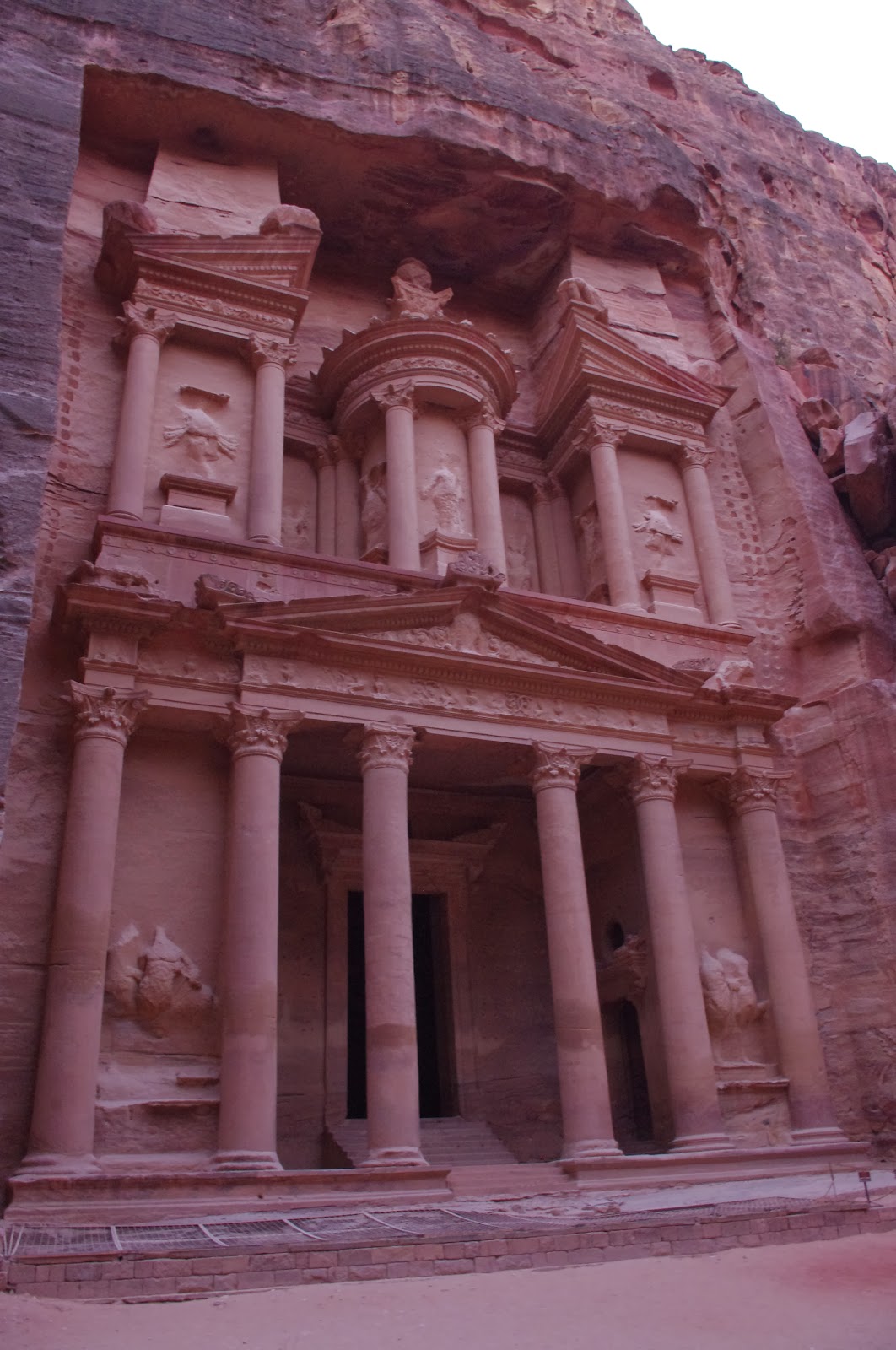
Petra, famous for the 'Treasury' and its role in Indiana Jones. But there is so much more to Petra than one famous site. In fact, it is a sprawling site, hidden for centuries and a testament to the ingenuity of an ancient civilization. But before you read on, I encourage you to check out the famous scene one last time.
 |
| The Treasury |

Petra was lost to Westerners until Swiss explorer Jean Louis Burckhard discovered it in 1812. What remains are over 800 tombs, facades and memorials. Mary, Anne and I did our level best to see what we could.
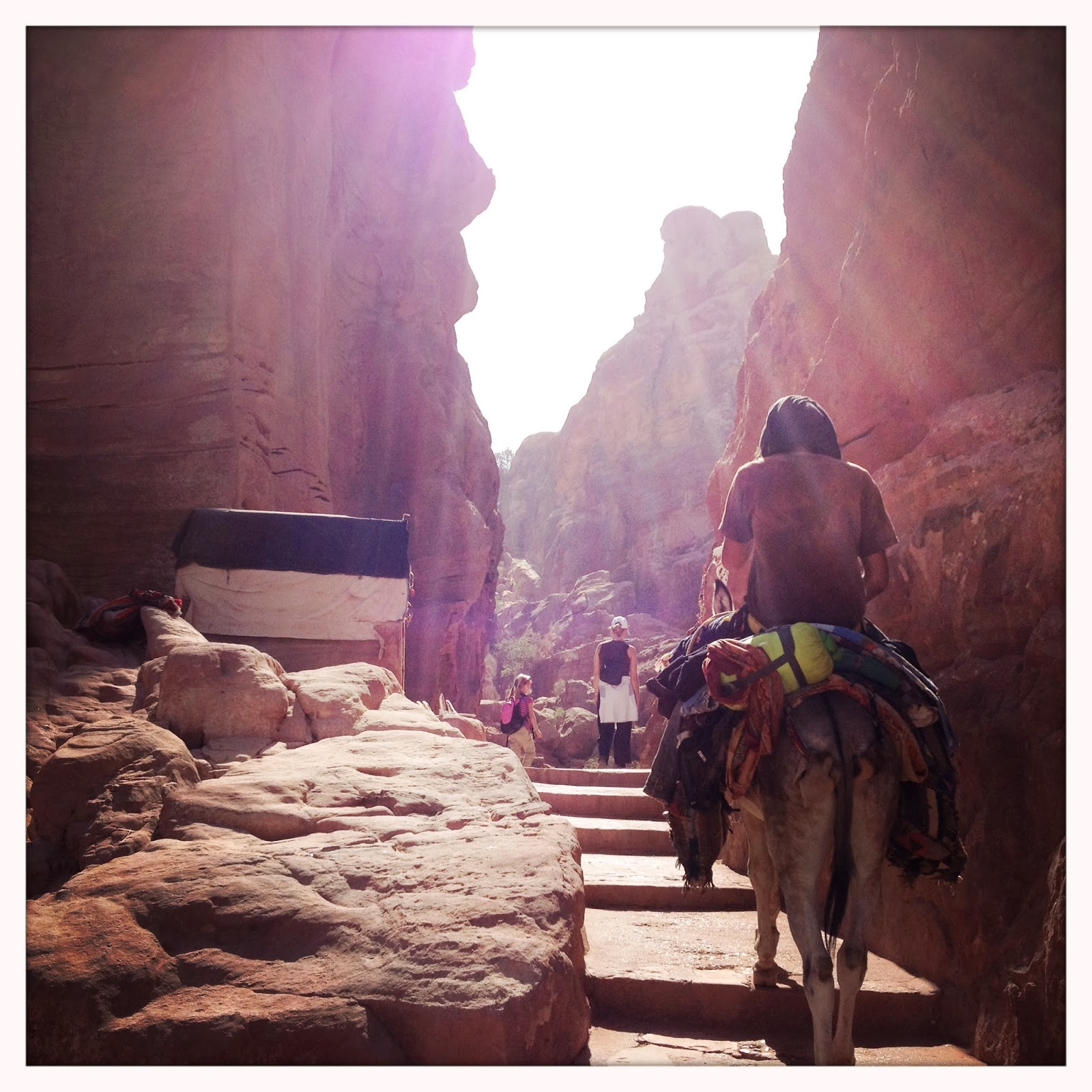 |
| Donkeys Are Available for Those Too Tired to Walk |

Petra has been named one of the seven wonders of the world, and after visiting, it is easy to see why. After about 5 hours of treking, Mary and Anne headed back to the hotel, and I took a hike up to the Monastary, the largest and one of the most remote of the facades.
 |
| Anne Poking Her Head Through |
 |
| The Monastary (800 stairs later) |
 |
| The Treasury at Dusk |
 |
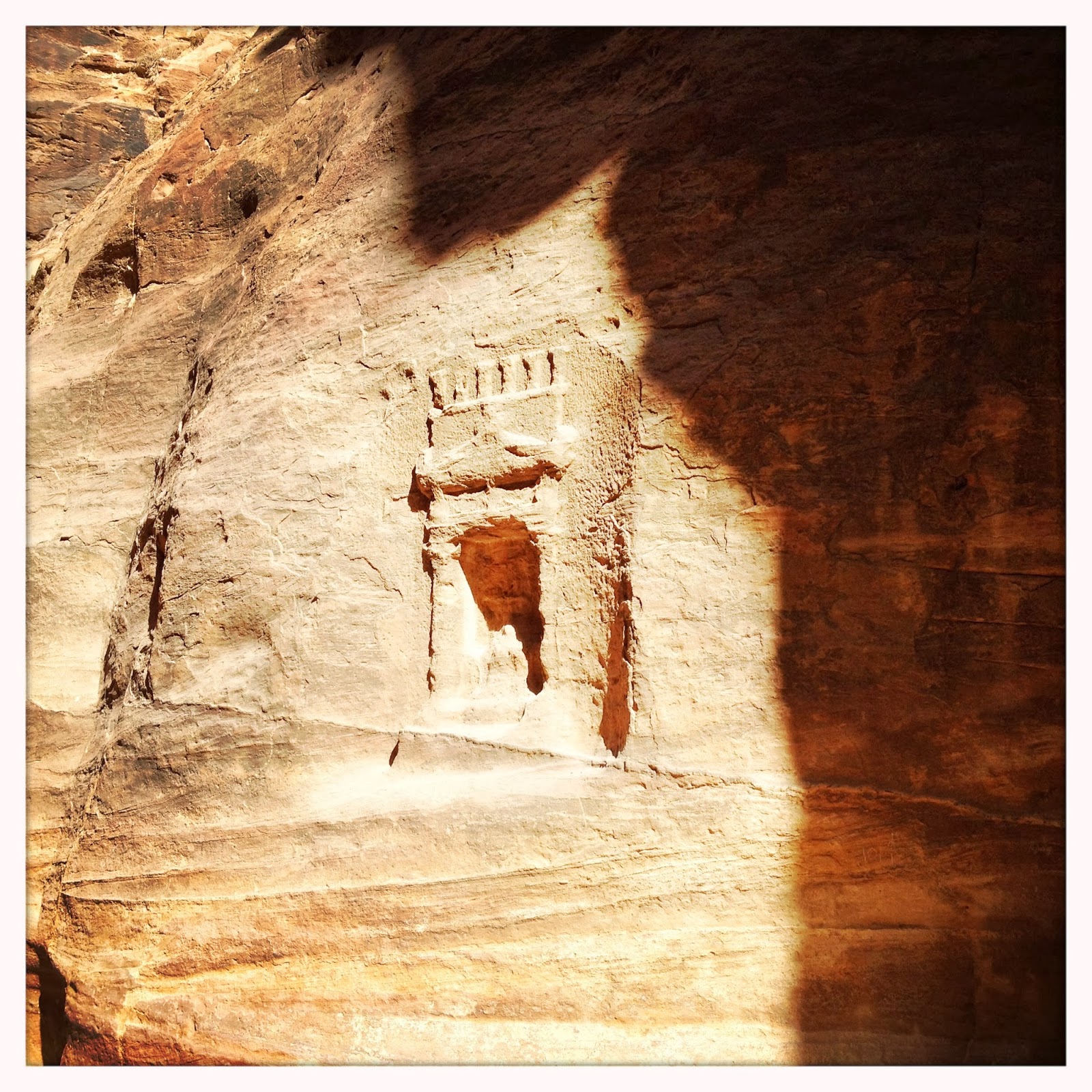
| Amazing Colors |
 |
| The Treasury Peeks Through |

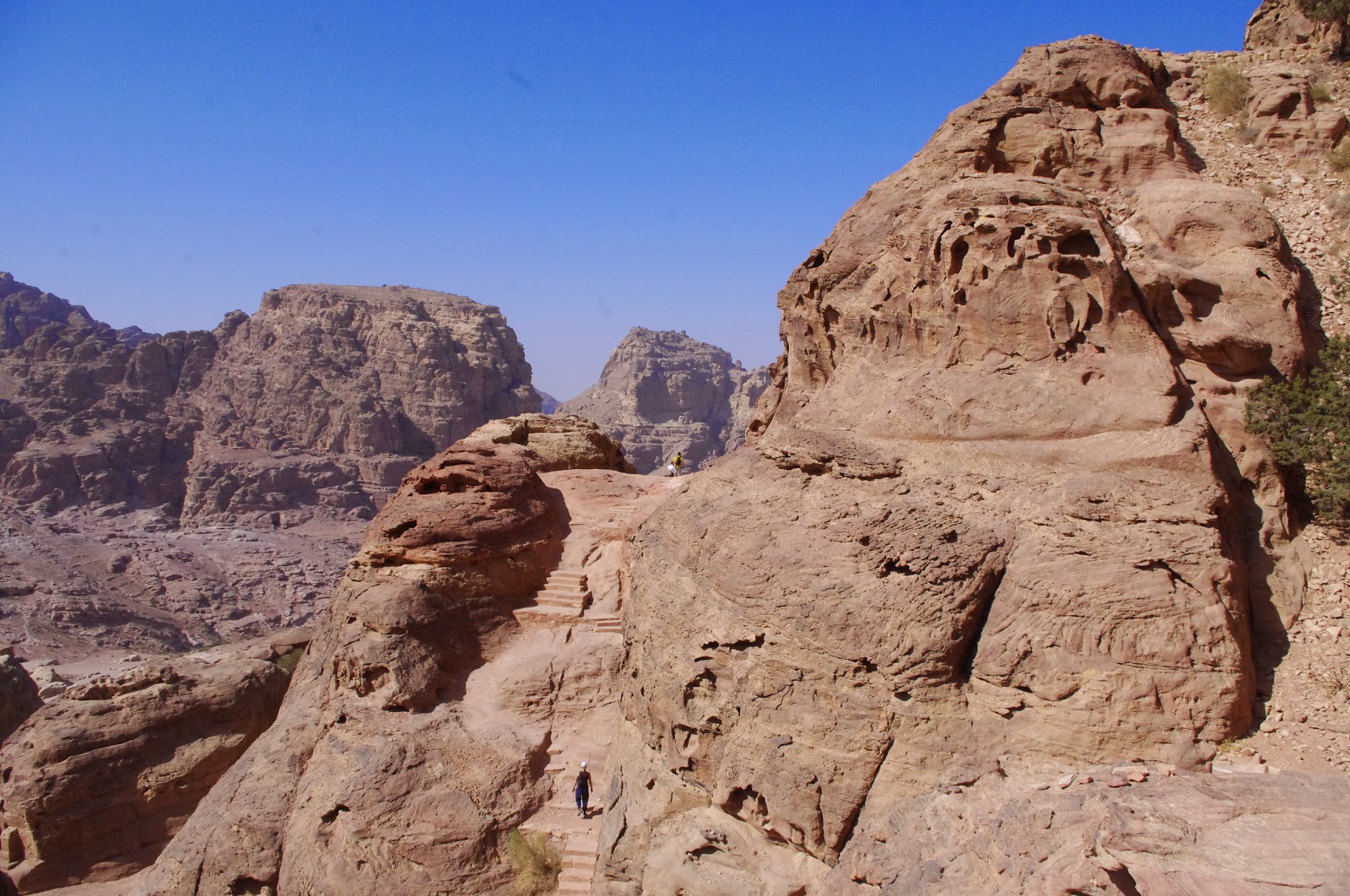 |
| Look Close! You can see Anne and Mary crossing the hill. |
 |
| Ancient Shelter |

 |
| A Camel Says Hello |
Madaba and the King's Highway
 |
| Goat Anyone? |
The history of Jordan is amazing to me, even the history since the early 20th century is amazing. With the end of WWI and the Ottoman Empire, the country of Trans-Jordan was established. Names like T.E. Lawrence, Sykes, etc., have shaped this country's history, along with the long history of the Bedouins, the Nabateans, and the Romans. Currently, Jordan sees itself as a pillar of stability in a region battered by instability. Jordan is surrounded on all sides by conflict, Iraq to the West, Syria to the North, Israel and Palestine to the West, and the Wahhabi tendencies of Saudi Arabia to the South. The country of Jordan struggles economically, and is in fact among the poorest in terms of natural resources, they don't have oil, iron, rain or ground water. Until recently they received heavily subsidized natural gas from Iraq and Egypt. Saudi Arabia has allowed them to establish wells across their border to pump groundwater. The rich countries of the gulf have provided billions of dollars of grants and low interest loans, designed to keep the government's head above water and maintain stability. In the middle of the Arab Spring, the government reduced the subsidy on gasoline and was met with demonstrations and riots. Since that time, subsidies have remained in place, though they are unsupportable over the long term. To make matters worse the situation in Syria has resulted in hundred's of thousands of refugees streaming across the border, further straining an already tenuous system. All that being said, Jordan remains safe, hospitable and beautiful.
 |
| The Madaba Tree |
 |
| A Portion of the Mosaic Map |
 One of the most iconic of these Mosaics is the Madaba Tree which was found in many of the destroyed homes and serves as the symbol of the city.
 |
| Stone Cutting Staion |
 |
| Madaba Tree in Progress |
The King's highway winds its way down the central spine of Jordan, crossing two large Wadi's that the locals consider the their version of the Grand Canyon, they are truly impressive and after winding our way down to the bottom and back to the top, we were greeted with beautiful views

Saturday, November 2, 2013
Amman, Jerash, Al Joun


On Saturday we drove about 45 minutes north to Jaresh. This is the site of some of the best Roman ruins outside of Rome.


Jaresh houses the ruins of temples from Roman Gods Hercules and Artemis to Christian sanctuaries. The mosques across the street are visible from just about any spot. We really have a smorgasbord, but we are used to it. When we were growing up there were 26 churches in Greenville, with only 6000 people. So, you know, we are very tolerant of all different kinds of crazy spiritual practice.


About 30 minutes through the mountains we came to Al Joun, the birthplace of the Prophet Elijah. There is a a castle way up on top of the mountain. This was Anne's first castle. She saw a lot of castles in Morocco and we live by palaces in Kuwait but she had never been into a castle before. This one had all the things a little girl imagines. Now, we are not anti-disney and I could almost sing theme song to Sophia the 1st for you if you needed. So I didn't know what to expect from Anne except for the fact that she is a (in my biased opinion) super well rounded and not princess crazy. So when she wanted to scope out the dungeon to find the dragon and wanted to play guards and knights and climb to the top of the castle. I was pretty proud. There was no talk of Disney. She has seen enough real history to understand that what she sees on Disney is not real. She has hiked enough mountains and waited in long enough lines. We are doing our part to help even out all that princess business. But, I am the one that said prior to leaving Kuwait, What!? YOU mean we are going to be missing the Marine Ball while we are in Jordan? We need to find out if we can go in Jordan then.... I am the one with a princess complex.


Tonight we had dinner with the other IRT FAO families here in Jordan. It was so nice to see familiar faces and eat amazing Lebanese food. Tomorrow Anne and I will be visiting the parents of Arabic teacher from when we lived in California.
Mary.
Saturday, October 12, 2013
Regular Day
Since Anne was about 2 she would ask me if we were going to have a "regular day" or if we had plans. Her idea of a "regular day" was one where she knew what to expect, we generally stayed home or went to school and came home. We would eat at home, and be together. Given that we have had so many different homes in different cities each with a different set of circumstances (Tim deployed/ or not, Me working full/part time or not, Anne going to school full/half day or not) having a "regular day" when its just us, all of us, at home, has always been something of a holiday.
Today however I realized that our whole time in Kuwait has been filled with regular days. We have been together so much, eating at home, spending time working and playing together. There are many things to do in Kuwait but much of what we do here is "play" house.
My sister Claire said to me the other day that she wanted to know about the normal things in Kuwait. She said "Tell me what its like to cross the street". I said "I don't cross the street". This is true. Though we walk to restaurants and church and the club we stay on the same side of the street. If I wanted to cross the street most likely I would get in the car and drive there. It sounds totally ridiculous but the traffic and the drivers here make it next to impossible to safely cross the street. So, if perchance I needed to go on the other side of the road outside of our compound I would go down to the garage and get in our just arrived car (Yippee, it only took 3 months!!!) Drive out of the garage through security. Make a right when the lights are changing. Move over three lanes. Head to the stoplight into the U-turn lane. Wait. wait. wait. The stoplights in Kuwait only go one direction at a time so if you get to an intersection right when they have turned you have to wait about 5 min. On green make my U-Turn, move over three lanes and exit into the side road or parking lot of my "Across the street" neighbors.
So yes, we drive everywhere. But, as our oil company lawyer friend Petra said on Saturday night, "Kuwait is floating on oil." What cost me $70.00 to fill'er up in California costs $6KD here- roughly $20USD.
Today we went for a drive to see some of the oil refineries south of us. Not really on purpose. We were driving down to the only Mexican restaurant we know of in Kuwait and just decided to see what we could see see see. This is about 20 minutes south of our house.

In order to appreciate the wealth that comes from this liquid gold we have gone to a couple of museums and tours while Anne is in school. Tim is supposed to take time to do In Country Training which includes the cultural aspects of Kuwait. We went to the Arab Organization Headquarters two weeks ago. The architecture and artistry of this building is amazing. And the first good skyline we have seen of Kuwait during the day!


The Arab headquarters has eight executive conference rooms. Each is themed. This one in the Tunisian room. I loved seeing the zellij tile work from Tunisia. Anne and I won't get to go to Tunis due to the current political condition. But we had almost 18 months of dreaming of living there before the tragedy in Libya. The table you see here is a slab of marble weighing 2.5 tons. It is shaped as a diamond so that the 40 people sitting at the table can see each other. Each chair is made of the finest leather and we were told costs $3000USD a piece. As soon as our tour guide said that Tim sat down. Let me know the next time you spend $120K on chairs.
Below is the courtyard of this amazing building. We are on the 4th floor looking down. The trees are all real and swivel 360 degrees so that they grow straight. Tim and I were struck by the birds and the birdcages. It was so beautiful to be indoors but feel as if we were in a natural setting. (and not have to be in 100 degrees).

From the 4th floor is a 4-floor (up to the 8th floor) Wall of glass. We were told it is the largest pure wall of glass in the world.

 There is no good way to give perspective on this wall. It is huge. Each panel of glass is 1 story of the building.

 Turning around to the other side of the courtyard is the world's largest continuous handmade wooden structure with no nails or glue, only male and female parts. It is a common style of lattice work in the middle east called Mashrabiya. This one is 8 stories tall, the height of the courtyard. The previous picture is on the back side also on the 4th floor. Below is a video of an Eygptian man making pieces.
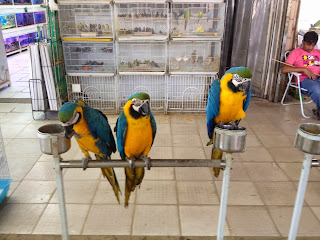
We really enjoyed our tour of the the Arab Headquarters so much that when we were leaving Tim and I decided that we would like to get Anne some birds for our house. So today we drove over to the Friday Market (also open on Saturdays). This is a huge outdoor market of traditional Kuwaiti goods. We first shopped for rugs. We found 2 that we like but will return to buy them some other time. These are from Iran.

Then we headed over to the Animal Market attached to the Friday Market. There were thousands upon thousands of Rams and Sheep today. This coming week is the Eid al-Adha. This is a two day celebration of Abraham's sacrifice of his first born son (in Christianity) Isaac (in Islam) Ishmael. Traditional Muslim families buy and sacrifice a ram or lamb to eat during this holiday. Not everyone owns a farm truck, but everyone gets their celebratory feast.
Information on the controversy surrounding mass slaughtering of sheep in Kuwait.
We did not stop here. We went on to the bird houses. We found the most wild chickens....
We kept walking past these little guys and found ourselves at bird buyers wholesale. We ended up buying a pair of royal Budgerigars (a common kind of parakeet). But you can buy big parrots and other crazy exotic birds at Friday Market.


Today however I realized that our whole time in Kuwait has been filled with regular days. We have been together so much, eating at home, spending time working and playing together. There are many things to do in Kuwait but much of what we do here is "play" house.
My sister Claire said to me the other day that she wanted to know about the normal things in Kuwait. She said "Tell me what its like to cross the street". I said "I don't cross the street". This is true. Though we walk to restaurants and church and the club we stay on the same side of the street. If I wanted to cross the street most likely I would get in the car and drive there. It sounds totally ridiculous but the traffic and the drivers here make it next to impossible to safely cross the street. So, if perchance I needed to go on the other side of the road outside of our compound I would go down to the garage and get in our just arrived car (Yippee, it only took 3 months!!!) Drive out of the garage through security. Make a right when the lights are changing. Move over three lanes. Head to the stoplight into the U-turn lane. Wait. wait. wait. The stoplights in Kuwait only go one direction at a time so if you get to an intersection right when they have turned you have to wait about 5 min. On green make my U-Turn, move over three lanes and exit into the side road or parking lot of my "Across the street" neighbors.
 |
| Tim dropped the Land Rover off at the port in CA on June 28th. We got it here in Kuwait on Tues Oct 8th |
So yes, we drive everywhere. But, as our oil company lawyer friend Petra said on Saturday night, "Kuwait is floating on oil." What cost me $70.00 to fill'er up in California costs $6KD here- roughly $20USD.
Today we went for a drive to see some of the oil refineries south of us. Not really on purpose. We were driving down to the only Mexican restaurant we know of in Kuwait and just decided to see what we could see see see. This is about 20 minutes south of our house.

 |
| I guess oil refineries look the same everywhere. |


The Arab headquarters has eight executive conference rooms. Each is themed. This one in the Tunisian room. I loved seeing the zellij tile work from Tunisia. Anne and I won't get to go to Tunis due to the current political condition. But we had almost 18 months of dreaming of living there before the tragedy in Libya. The table you see here is a slab of marble weighing 2.5 tons. It is shaped as a diamond so that the 40 people sitting at the table can see each other. Each chair is made of the finest leather and we were told costs $3000USD a piece. As soon as our tour guide said that Tim sat down. Let me know the next time you spend $120K on chairs.
Below is the courtyard of this amazing building. We are on the 4th floor looking down. The trees are all real and swivel 360 degrees so that they grow straight. Tim and I were struck by the birds and the birdcages. It was so beautiful to be indoors but feel as if we were in a natural setting. (and not have to be in 100 degrees).

From the 4th floor is a 4-floor (up to the 8th floor) Wall of glass. We were told it is the largest pure wall of glass in the world.


We really enjoyed our tour of the the Arab Headquarters so much that when we were leaving Tim and I decided that we would like to get Anne some birds for our house. So today we drove over to the Friday Market (also open on Saturdays). This is a huge outdoor market of traditional Kuwaiti goods. We first shopped for rugs. We found 2 that we like but will return to buy them some other time. These are from Iran.

 |
| Tim discussing the cost...not nearly as dramatic as in the Souks in Morocco. |
Then we headed over to the Animal Market attached to the Friday Market. There were thousands upon thousands of Rams and Sheep today. This coming week is the Eid al-Adha. This is a two day celebration of Abraham's sacrifice of his first born son (in Christianity) Isaac (in Islam) Ishmael. Traditional Muslim families buy and sacrifice a ram or lamb to eat during this holiday. Not everyone owns a farm truck, but everyone gets their celebratory feast.
 |
| Not our car!!! |
We did not stop here. We went on to the bird houses. We found the most wild chickens....
.jpg) |
| It is very popular to dye chicken and rabbits. Just for the record, Anne said "That is so mean!!" |


Meet Will and Kate
So today was not a regular day. But it was a fun day in Kuwait and being that the high was merely 93 and right now it is 70, we are all settling in just fine.
In other news... big shoes to fill in March...
 |
| bought these in Morocco on a hunch... |
Subscribe to:
Posts (Atom)